


Plate Boundaries: Convergent

This blog is under the topic "Pacific Ring of Fire". Honestly! An idea comes up in our minds from reading just the blog title but those ideas are not strong enough to explain what are these. Continue reading this blog to have firm ideas and concepts about plate boundaries, specifically the Convergent one.

Three Types of Convergent Plate Boundaries
Earth's outer layer, the crust, is divided into a set of large moving plates. The lines where they meet are called plate boundaries. [1] The skin is divided into about a dozen tectonic plates. Plate boundaries are always faults, but not all faults are plate boundaries. The movement of the plates relative to each other distorts the crust in the region of the boundaries creating systems of earthquake faults. [2] There are three main types of plate boundary: convergent, divergent and transform. [1]
Take note:
PLATE BOUNDARIES ARE ALWAYS FAULTS,
BUT NOT ALL FAULTS ARE PLATE BOUNDARIES
For now, let's just focus on the first main type of plate boundaries, the Convergent boundary.
Convergent boundary
~ Convergent plate boundaries are locations where lithospheric plates are moving towards one another. The plate collisions that occur in these areas can produce earthquakes, volcanic activity, and crustal deformation. [3] It is a region of active deformation where two or more tectonic plates or fragments of the lithosphere are near the end of their life cycle. It is also known as a destructive plate boundary. [4] A convergent plate boundary is formed by tectonic plates crashing into each other. [5]
When continental and oceanic plates collide, the thinner and more dense oceanic plate is overridden by the thicker and less dense continental plate. The oceanic plate is forced down into the mantle in a process known as "subduction." [3]
Plate boundaries are said to be Convergent if two plates are colliding.
Subduction zones occur when one or both of the tectonic plates are composed of oceanic crust. The denser plate is subducted underneath the less dense plate. The plate being forced under is eventually melted and destroyed.
THREE TYPES OF CONVERGENT PLATE BOUNDARIES

Oceanic Crust meets Oceanic Crust
i. Where oceanic crust meets ocean crust. Island arcs and oceanic trenches occur when both of the plates are made of oceanic crust.
Zones of active seafloor spreading can also occur behind the island arc, known as back-arc basins. These are often associated with submarine volcanoes. [5]
Japan, the Aleutian Islands, and the Eastern Caribbean islands of Martinique, St. Lucia, and St. Vincent and the Grenadines are examples of islands formed through this type of plate boundary. [3]

Oceanic Crust meets Continental Crust
ii. Where oceanic crust meets continental crust. The denser oceanic plate is subducted, often forming a mountain range on the continent. The Andes is an example of this type of collision. [5]
The Washington-Oregon coastline of the United States is an example of this type of convergent plate boundary. Here the Juan de Fuca oceanic plate is subducting beneath the westward-moving North American continental plate. The Cascade Mountain Range is a line of volcanoes above the melting oceanic plate. The Andes Mountain Range of western South America is another example of a convergent boundary between an oceanic and continental plate. Here the Nazca Plate is subducting beneath the South American plate. [3]
Continental Crust meets Continental Crust
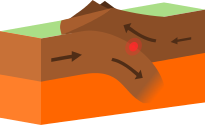
iii. Where continental crust meets continental crust. Both continental crusts are too light to subduct so a continent-continent collision occurs, creating especially large mountain ranges. The most spectacular example of this is the Himalayas. [5]
The Himalaya Mountain Range is the best active example of this type of plate boundary. The Appalachian Mountain Range is an ancient example of this collision type and is also marked on the map. [3]
References:
[1] www.bbc.co.uk/science/earth/surface_and_interior/plate_boundary [2] http://www.openhazards.com/faq/earthquakes-faults-plate-tectonics-earth-structure-user-submitted-questions/what-relationship [3] http://geology.com/nsta/convergent-plate-boundaries.shtml [4] https://en.wikipedia.org/wiki/Convergent_boundary [5] https://www.nationalgeographic.org/encyclopedia/ring-fire/


Comments